
Korean Lessons ᚛ Level 4 - Intermediate Korean #1 (Lessons 91 to 120) ᚛ Lesson 103 - In the middle of, in the process of in Korean [중] [-는 중]
In the middle of, in the process of in Korean [중] [-는 중]
In Korean, to express the fact that something is currently happening, with an idea of progression over time, it is possible to use the little word 중. In English, this would generally be translated by expressions like "in the middle of", "in the process of", "in progress", "currently"... etc.
After a noun
In Korean, if we want to say that something or someone is "in the middle of ...", we use the following form:
[Noun] 중
공사 중
→ Under construction
회의 중
→ In a meeting
To form a sentence with 중, the verb 이다 or the time particle 에 are generally used.
다이어트 중이야.
→ I’m on a diet. (Lit: I am in the middle of a diet.)
수업 중에는 전화를 받을 수 없습니다.
→ You cannot take phone calls during class.
아내는 지금 임신 중이에요.
→ My wife is pregnant right now. (Lit: My wife is in the middle of a pregnancy right now.)
여행 중에 친구를 만났어요.
→ I met a friend during my trip.
After a verb
It is possible to use 중 with a verb to express the fact that something or someone is in the middle of an action, is currently carrying out an action. This is expressed in the following manner:
[Present adjectival form] 중
The adjectival form in -는 was seen in the chapter on adjectives in Korean.
가는 중
→ in the middle of going
먹는 중
→ in the middle of eating
The -는 중 structure is very close to the progressive tense -고 있다 seen in a previous chapter.
저는 한국어를 배우는 중이에요.
저는 한국어를 배우고 있어요.
→ I am learning Korean. / I am in the middle of learning Korean.
나갈 준비하는 중입니다.
→ I am getting ready to go out.
철수야 어디야? 오는 중이야?
→ Cheolsu, where are you? Are you on your way?
심심해서 노래하는 중이에요.
→ I’m singing because I was bored.
그때는 점심 먹는 중이었어.
→ At that moment, I was in the middle of eating lunch.
그때는 저녁 먹는 중일 거야.
→ At that moment, I will be in the middle of eating dinner.
Summary table of structure
Learn more
Exercises
Learn more
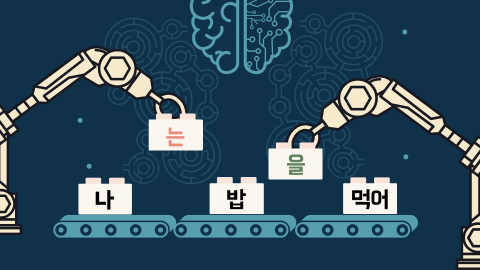
Particles are omnipresent in Korean. They indicate the role of words in a sentence, nuance meaning, and make it possible to understand who does what, where, how, and why.
Particles are also often the aspect that causes the most difficulty for Korean learners. In grammar books, they are usually presented in the middle of long sentences, with complex vocabulary, without being clearly highlighted.
With Korean Particles, we made the opposite choice:
taking the time to explain each particle, one by one, using very simple sentences, accessible even to beginners.
