
Korean Lessons ᚛ Level 6 - Upper-Intermediate Korean #1 (Lessons 151 to 180) ᚛ Lesson 174 - Unlikely condition in Korean [-(ㄴ/는)다면]
Unlikely condition in Korean [-(ㄴ/는)다면]
The unlikely condition with -(ㄴ/는)다면
In Korean, if we want to express the idea that a condition must be met in order to carry out an action, but that this condition is unlikely, we can use the following structure:
[Condition: … Verb conjugated in the neutral style]면 [Action]
By using the -(ㄴ/는)다면 structure on an action, we indicate that there is relatively little chance of it happening, very little chance, or even that it belongs to the realm of imagination.
In English, the -(ㄴ/는)다면 structure can be translated by a simple conditional "if", or be reinforced by expressions that show a low probability such as "if ever", "if by any chance", "if by some luck", ...
지금 네가 내 앞에 나타난다면 너무나 기쁠 것 같아.
→ If you appeared in front of me right now, I would be so happy.
주원이는 복권을 살 때마다 "이번에 당첨된다면 내가 차 한 대 뽑아 줄게."라며 허세를 부렸어.
→ Every time Juwon bought a lottery ticket, he would show off, saying, "If I ever win this time, I’ll buy you a car."
지우랑 함께 시간을 보냈다면 이렇게 지루하지는 않았을 텐데...
→ If I had spent time with Jiwoo, I wouldn’t have been this bored...
몇 년 동안 만나지 못했던 그 사람을 다시 만난다면 그때는 꼭 이전에 하지 못했던 말들을 다 할 생각입니다.
→ If I ever meet again that person I haven’t been able to see for several years, I intend to tell them everything I couldn’t say back then.
내 이야기를 들어 줄 사람만 있다면 누구에게라도 이 억울함을 하소연하고 싶어.
→ If only there were someone to listen to my story, I would want to pour out this feeling of injustice to anyone at all.
만약 내가 부자라면 큰 집이랑 멋진 차를 사고 세계 여행도 할 텐데요.
→ If by any chance I were rich, I would buy a big house and a nice car, and I would probably travel around the world too.
-(ㄴ/는)다면 and indirect speech
Learn more
Exercises
Learn more
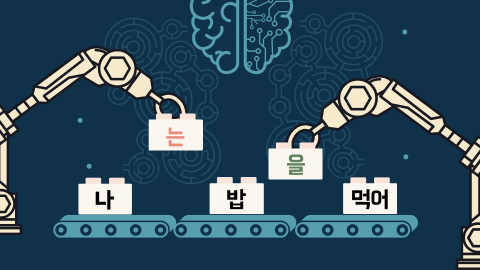
Particles are omnipresent in Korean. They indicate the role of words in a sentence, nuance meaning, and make it possible to understand who does what, where, how, and why.
Particles are also often the aspect that causes the most difficulty for Korean learners. In grammar books, they are usually presented in the middle of long sentences, with complex vocabulary, without being clearly highlighted.
With Korean Particles, we made the opposite choice:
taking the time to explain each particle, one by one, using very simple sentences, accessible even to beginners.
