
Korean Lessons ᚛ Level 6 - Upper-Intermediate Korean #1 (Lessons 151 to 180) ᚛ Lesson 172 - Supposition and contrast in Korean [-(으)ㄹ 텐데]
Supposition and contrast in Korean [-(으)ㄹ 텐데]
In Korean, the little word 터 is used to express a supposition or an intention. However, it is never used on its own. Combined with the descriptive verb "to be" 이다, that is 터이다, it gave the form 테다.
Although 테다 can be used as such in some cases, it is most often used with various structures. In this lesson, we are going to study the form -(으)ㄹ 텐데, a combination of the modifier -(으)ㄹ, of 테다 and of the contrast structure -(으)ㄴ/는데(요).
Supposition with -(으)ㄹ 텐데 in the middle of a sentence
Used in the middle of a sentence, 텐데 allows us to make a supposition in the first part of the sentence and then to give an explanation, express a contrast or make a request in the second part of the sentence, just like the -(으)ㄴ/는데 structure. It is used in the following manner:
[Action 1: ... Modifier -(으)ㄹ] 텐데 [Action 2]
Compared to the simple -(으)ㄴ/는데 structure, the -(으)ㄹ 텐데 structure adds the idea of a strong supposition: we are almost certain that the statement is true, that the action is happening or is going to happen (present stem), or that it happened (past stem).
오늘 저녁에 비가 올 텐데 우산을 가져가는 게 어때요?
→ It will probably rain this evening, how about taking an umbrella?
오늘 하루종일 일해서 배고플 텐데 내가 만든 것 좀 먹어 봐.
→ You must be hungry since you worked all day today, so have some of what I made.
학생이라서 돈이 많이 없을 텐데 무슨 선물까지 준비했어.
→ You can’t have much money since you’re a student, and yet you even prepared a gift for me.
기차가 이미 떠났을 텐데 서두르지 말고 천천히 가자.
→ The train must have already left, so let’s not rush and take our time.
요즘 결혼 준비로 아주 바쁘실 텐데 방문해 주셔서 감사합니다.
→ You must be very busy with the wedding preparations these days, thank you for coming to visit me.
휴일이라서 영화관에 사람 많았을 텐데 빈자리가 있었어?
→ Since it was a holiday, the movie theater must have been crowded, were there any seats left?
고양이가 매번 어질러서 금세 더러워질 텐데 왜 그렇게 열심히 청소를 하는 거야?
→ The cat makes a mess every time, so it will surely get dirty again soon, so why are you cleaning so hard?
옷이 작아서 맞지 않을 텐데 수진이는 계속해서 그 옷을 입어 보겠다고 엄마를 졸랐어요.
→ The clothes were small, so they surely wouldn’t fit her, but Sujin kept pestering her mother, saying she wanted to try them on.
Supposition with -(으)ㄹ 텐데(요) at the end of a sentence
Learn more
Exercises
Learn more
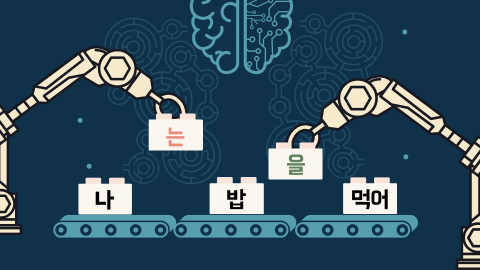
Particles are omnipresent in Korean. They indicate the role of words in a sentence, nuance meaning, and make it possible to understand who does what, where, how, and why.
Particles are also often the aspect that causes the most difficulty for Korean learners. In grammar books, they are usually presented in the middle of long sentences, with complex vocabulary, without being clearly highlighted.
With Korean Particles, we made the opposite choice:
taking the time to explain each particle, one by one, using very simple sentences, accessible even to beginners.
